THE FRAMEWORK

THE TEN CAPABILITIES.

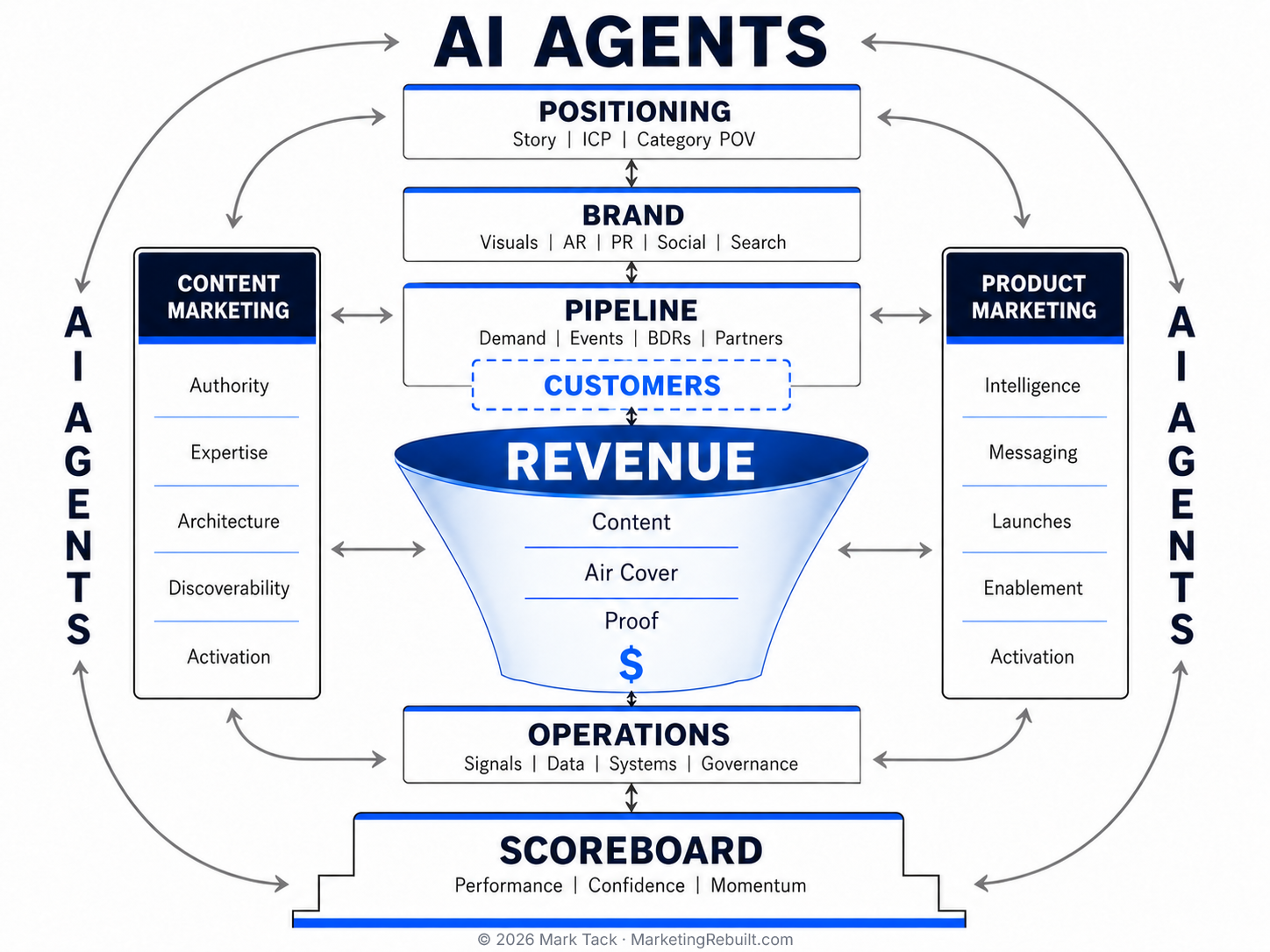
The AI Marketing Engine is one connected system, and AI agents change how the work gets done across every part of it. Signals flow through every capability, agents handle a lot of the work, humans guide the decisions that matter, and pipeline and revenue come out the other end.

The AI Marketing Engine framework by Mark Tack, ten connected capabilities
01

AI Agents.

You cannot get through a conference, a board meeting, or a marketing leadership conversation without agents coming up. Some companies are all in. Others are experimenting with a few tools and trying to figure out what works. Some teams are just frozen. Launching random agents and hoping for magic won't get you far. Real progress comes from building an actual system where signals come in, agents do real work, and humans still make the calls that matter.

What it does

Runs agent-powered work across the engine while people retain direction and accountability.

What changes with AI agents

Signals can initiate research, drafting, monitoring, routing, and execution without waiting for someone to spot the need. People review the decisions that require judgment.

Why it matters to a CEO

An agent is useful when it improves a business outcome, not simply when it automates an activity. A connected system makes that difference visible.

02

Scoreboard.

If you can't see the system, you can't run it. The Scoreboard is system intelligence built into the engine from the start, organized around three pillars: performance, confidence, and momentum. Get this right, and you stop defending marketing in the boardroom and start leading the conversation.

What it does

Shows whether the engine is producing, organized around three pillars: performance, confidence, and momentum.

What changes with AI agents

Measurement stops being a monthly reporting exercise and becomes system intelligence running continuously inside the engine.

Why it matters to a CEO

When marketing, sales, and finance quote three different pipeline numbers, every conversation starts with an argument about the data instead of a decision about the business.

03

Positioning.

The CEO and C-suite own overall strategy, but CMOs own how that strategy comes to life in the market: the narrative, the ideal customer profile, and the category point of view. Positioning is something you earn, not something you declare. The question is whether you have earned the position you want.

What it does

Translates business strategy into a narrative, an ideal customer profile, and a category point of view.

What changes with AI agents

Agents surface buyer language, competitive moves, and market feedback continuously. Humans decide which signals should change the story.

Why it matters to a CEO

A clear position focuses investment and gives the business a reason to win beyond price. Without it, execution scales confusion.

04

Brand.

Brand is the trust system. It's how the market experiences you before anyone talks to you. Built across five pillars (visuals, analyst relations, public relations, social, and search), Brand done well accelerates everything else in the engine. Done poorly, it costs you deals you'll never know you lost.

What it does

Builds market awareness and trust across visuals, analyst relations, public relations, social, and search.

What changes with AI agents

Agents monitor how the market experiences the company and help teams respond consistently across channels. People protect the promises the brand makes.

Why it matters to a CEO

Trust makes every sales conversation easier. Scaling execution without protecting it can create costs that never appear on a campaign report.

05

Pipeline Generation.

Pipeline is brass tacks. Everything else is important, but pipeline is where you find out whether any of it works. Forget MQLs. They measure activity. Pipeline measures outcomes. Agents scale execution across demand, events, BDRs, and partners. Humans still decide where to place the bets.

What it does

Creates quality pipeline across demand, events, BDRs, and partners.

What changes with AI agents

Agents connect buying signals with relevant outreach and follow-up across sources. Humans still choose the audiences, offers, and investments.

Why it matters to a CEO

Pipeline is evidence that the market is responding. The goal is qualified opportunities, not a larger activity report.

06

Customer Marketing.

B2B businesses create pipeline in two places: from the market and from the customers they already have. Most organizations dramatically overinvest in the first. Customer Marketing runs the second across three pillars: lifecycle engagement, expansion enablement, and advocacy. Expansion is pipeline. It deserves a target and an owner, right next to the new-logo number.

What it does

Builds expansion pipeline through lifecycle engagement, expansion enablement, and advocacy.

What changes with AI agents

Agents monitor customer signals and help connect them to timely engagement, expansion opportunities, and advocacy. People own the customer relationship.

Why it matters to a CEO

Growth from existing customers deserves the same target and accountability as new-logo growth. Ignoring it leaves a second engine of revenue underused.

07

Revenue Acceleration.

Revenue Acceleration is the marketing capability that helps sales convert active opportunities faster and at higher rates, whichever pathway created them. In most companies, marketing disappears the moment the opportunity is created. Agents are what finally make it possible to stay, showing up inside the deal in real time with the right content, air cover, and proof.

What it does

Helps sales convert active opportunities faster and at higher rates, through coordinated content, air cover, and proof.

What changes with AI agents

Agents spot what a deal needs as the signals appear, instead of waiting for a rep to ask and a marketer to go find it.

Why it matters to a CEO

You already paid to create those opportunities. Marketing disappearing at the handoff is the most expensive habit in the funnel.

08

Content Marketing.

Content powers the engine. It runs vertically through the system, fueling Brand, Pipeline Generation, and Revenue Acceleration across five pillars: authority, expertise, architecture, discoverability, and activation. Humans orchestrate the narrative and judgment, while agents help create, optimize, and distribute at scale.

What it does

Creates and activates content that fuels Brand, Pipeline Generation, and Revenue Acceleration.

What changes with AI agents

Agents help create, optimize, and distribute content using live market and pipeline feedback. Humans maintain the narrative, expertise, and editorial judgment.

Why it matters to a CEO

Content should help buyers move and deals progress. More output without a clear connection to pipeline is not a business result.
09

Product Marketing.

Product marketing is the translation layer between what your product does and how the market perceives and values it. When it's weak, the damage shows up everywhere: confused buyers, flat launches, reps inventing positioning on the fly. Done well, Product Marketing makes everything else in the engine work better.

What it does

Translates product capabilities into market intelligence, messaging, launches, enablement, and activation.

What changes with AI agents

Agents bring buyer feedback and competitive signals into messaging and enablement faster. Humans determine what the product can credibly promise.

Why it matters to a CEO

Buyers and sales teams need a shared understanding of value. Strong product marketing prevents confused buying decisions and wasted launches.

10

Engine Operations.

Marketing operations was built to support people doing the work. Engine Operations runs a system where a growing share of the work starts and finishes without a person touching it. It rests on four pillars: trusted signals, consistent data, connected systems, and clear rules for what agents may do. Competitors can buy the same agents. What competitors cannot easily copy is the foundation you build around the signals and judgment specific to your business.

What it does

Runs the layer underneath everything else: trusted signals, consistent data, connected systems, and clear rules for what agents may do.

What changes with AI agents

Marketing operations was built to support people doing the work. Engine Operations runs a system where a growing share of the work starts and finishes without a person touching it.

Why it matters to a CEO

Competitors can buy the same agents. What they cannot copy is the foundation built around the signals and judgment specific to your business. It is also the capability most often named as the one that limits all the others.

THE ENGINE LOOP · ABCD

ALWAYS BE CONNECTING DOTS.

These ten capabilities are the engine, and none of them deliver what they could in isolation. The payoff comes when they run together.

Mark has used the same shorthand with his teams for years. ABCD. Always Be Connecting Dots. The event that should have changed the follow-up, the objection that should have changed the content, the signal firing in one system that should have triggered something in another.

Every good marketer can do this. What none of us could do was do it constantly. There were only so many hours, and the two halves usually sat in different teams.

Think of it like a closed electrical circuit. When one part of the system isn't wired in, the signal has nowhere to go, so the whole engine loses momentum. Once all ten capabilities are wired in, the signals start flowing through the system the way they were supposed to. The agents fire when they should, and the whole thing runs as one engine.

That's ABCD running all the time, people and agents doing it together across every capability at once instead of one person happening to notice.

  1. 01Pipeline Generation

    A target account starts showing real buying interest.

  2. 02Revenue Acceleration

    An active opportunity is identified as needing support.

  3. 03Content Marketing

    The material that fits this moment surfaces.

  4. 04Product Marketing

    The right messaging and proof get attached.

  5. 05Scoreboard

    The response and the business outcome get tracked.

One illustrative path. The full engine has many more.

Positioning sets the direction, and that direction ripples through everything downstream. It shapes how Brand shows up, which is how the story reaches buyers, and that is ultimately what drives pipeline. Pipeline activity then generates signals that feed back into Content Marketing. Those same insights flow into Product Marketing, sharpening messaging based on what the market is actually responding to. And that loops back into Positioning, because what you learn from real market feedback changes how you think about where you are headed.

↳ Market feedback returns to Positioning

Crawl. Walk. Run.

Nobody builds this overnight, and you shouldn't try to. Crawl. Walk. Run.

Crawling is one capability getting clearer and one agent-powered use case working. You're walking when a few signals, agents, and people connect into a motion you can repeat, and running when that holds across capabilities without anyone losing control of it.

PUT THE FRAMEWORK TO WORK

WHERE TO GO NEXT.

Score your engine with the Readiness Assessment, read the book, or get in touch.